
Water softeners
Central water softeners treat water comprehensively by reducing its hardness throughout the house. The units regenerate automatically and work on the basis of ion exchange resins.
Hard water is widespread in Germany. Hardness comes from dissolved calcium and magnesium compounds: depending on temperature these compounds precipitate out and form limescale deposits, the familiar boiler scale.
Hard water causes a lot of problems
- Higher consumption of detergents and cleaning products
- Irritated, dry and itchy skin after bathing
- Rough laundry that wears out faster in the wash
- White limescale deposits on taps and tiles
- Damage to heating systems and household appliances
Our models
You will find all our water softeners in the product overview : the intelligent Laser 300 , the value champion Fjord , the Laguna for large households and the discontinued Cliff .
How a central water softener works
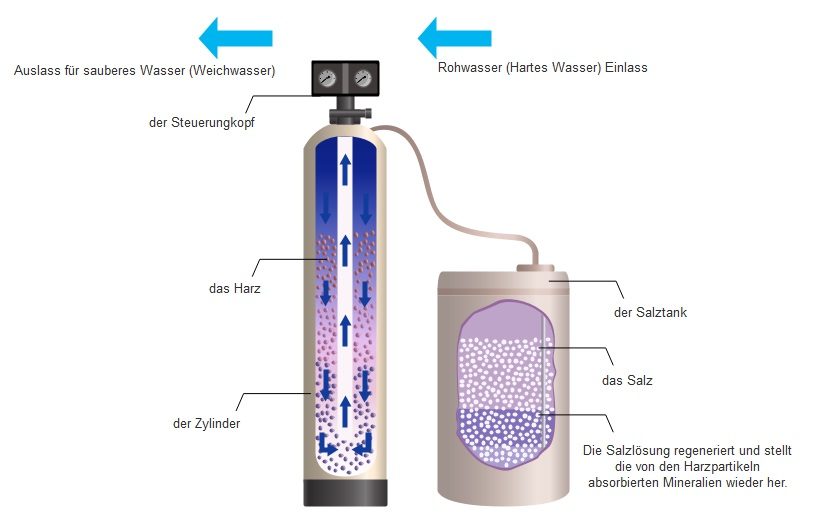
Diagram labels (original in German): Rohwasser (Hartes Wasser) Einlass = raw water (hard water) inlet · Auslass für sauberes Wasser (Weichwasser) = outlet for treated (soft) water · der Steuerungskopf = control head · das Harz = resin · der Zylinder = cylinder · der Salztank = salt tank · das Salz = salt · Die Salzlösung regeneriert … = the brine regenerates the resin and restores the minerals absorbed by the resin particles.
A central water softener consists of three main components:
The cylinder - a pressure vessel made of glass-fibre reinforced polyethylene and epoxy resin. Its size depends on the required capacity and is given in inches (e.g. 10×44: 10 inches diameter, 44 inches high).
The resin - an ion exchange resin that swaps calcium and magnesium ions for sodium ions as the water flows through. Ordinary regeneration salt is used to regenerate the resin.
The control head - controls the resin’s regeneration cycles. Modern volumetric heads measure how much water has passed through the softener and regenerate on demand; alternatively a fixed time interval can be set.
Installing a water softener permanently solves the typical hard-water problems: stubborn marks on shower doors, scale on taps, in the kettle and on heating elements, and deposits in coffee and tea all become a thing of the past.